Ukraine: from Recovery to Europe’s Green Growth Engine
Category:
 News
News
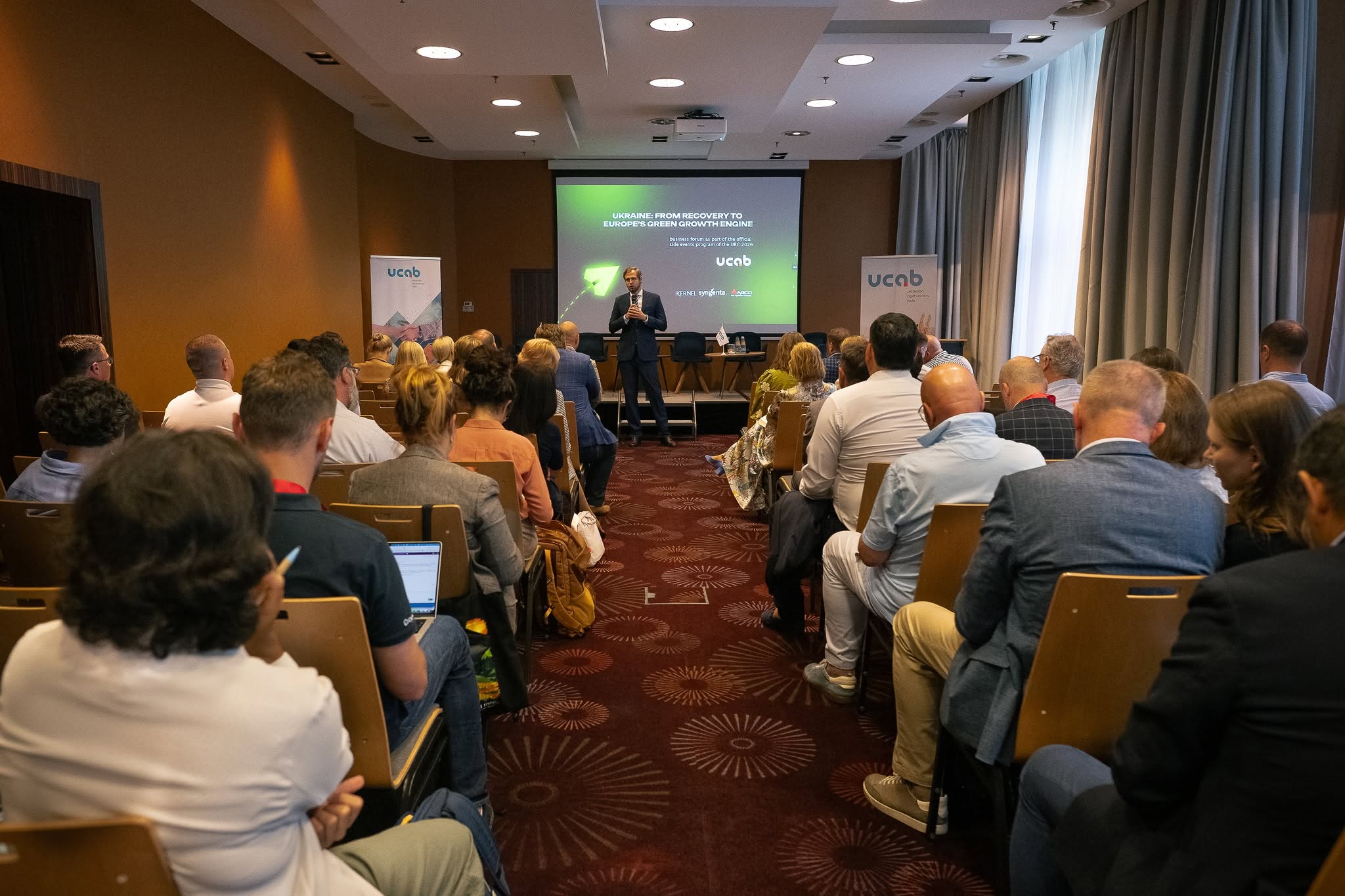
On June 24, as part of the official side event program of the Ukraine Recovery Conference (URC 2026), UCAB together with the UCABevent agency, held a closed business forum titled “Ukraine: from Recovery to Europe’s Green Growth Engine“. The discussion focused on ways to attract “green” financing, the development of the bioeconomy, the implementation of innovative smart farming technologies, and the harmonization of Ukrainian legislation with European environmental standards.
The event’s speakers emphasized the need for a paradigm shift: market participants should perceive climate requirements and the green transition not as a burdensome challenge, but as an opportunity for modernization and increased efficiency. The participants noted that Ukraine already has significant experience in implementing precision farming, which will facilitate the adaptation process to EU standards.
The following key takeaways were voiced during the event:
- The future of the Ukrainian agricultural sector lies in a technological leap: Ukraine has all the conditions to implement innovations in the field of smart farming that are not yet available to the rest of Europe. The transformation of domestic agriculture does not pose a threat or competition to the EU; on the contrary, it will generate benchmark solutions and “green” transition technologies that can later be scaled across the EU.
- There is a “trust gap” on the path to regenerative agriculture, as it is impossible to certify and sell what cannot be accurately measured. It is verified, audited field-level data collected in real time using comprehensive digital platforms and artificial intelligence that can bridge this gap and turn abstract environmental potential into very real “green” financing for businesses.
- To attract major international capital, businesses should move away from the concept of single projects and offer integrated ecosystems. When a foreign investor sees a diversified system of projects with transparent corporate governance, a clear plan, and the involvement of international financial institutions, it becomes a much more substantial guarantee for the safety of their funds than investing in a single isolated asset.
- The main financial challenge for domestic companies is not a lack of lending, but a deficit of equity capital. Commercial banks have sufficient liquidity to issue loans, but attracting external investors into capital is hindered by the fact that Ukrainian entrepreneurs are not ready to give up their shares due to the unfair and excessive discounting of their asset values.
- In the integration process, it is important to find the right balance so that new climate rules do not turn into an instrument of hidden trade protection. A prime example is the CBAM mechanism: enterprises that have already switched to more eco-friendly technologies are forced to pay more simply because European auditors physically refuse to travel to Ukraine to verify actual emission levels, creating bureaucratic barriers to fair free trade.
An important element of the discussion was the presentation of real business cases from European companies that continue to invest in Ukraine. Their experience in building renewable energy facilities and implementing smart technologies amidst a full-scale invasion is the best proof of the sector’s resilience.
We sincerely thank the guests and speakers for their candid thoughts, open dialogue, and constructive discussion of industry challenges in a trusted format. Special thanks for supporting the event go to our partners – Kernel, Syngenta, and AGCO. We hope that the vectors of dialogue established here will become the foundation for the “green” recovery of Ukraine and the strengthening of joint European potential on the global market.