Oleksandra Avramenko: “In times of war, the availability of food stocks in the country does not guarantee their automatic physical accessibility for the population”
Category:
 News
News
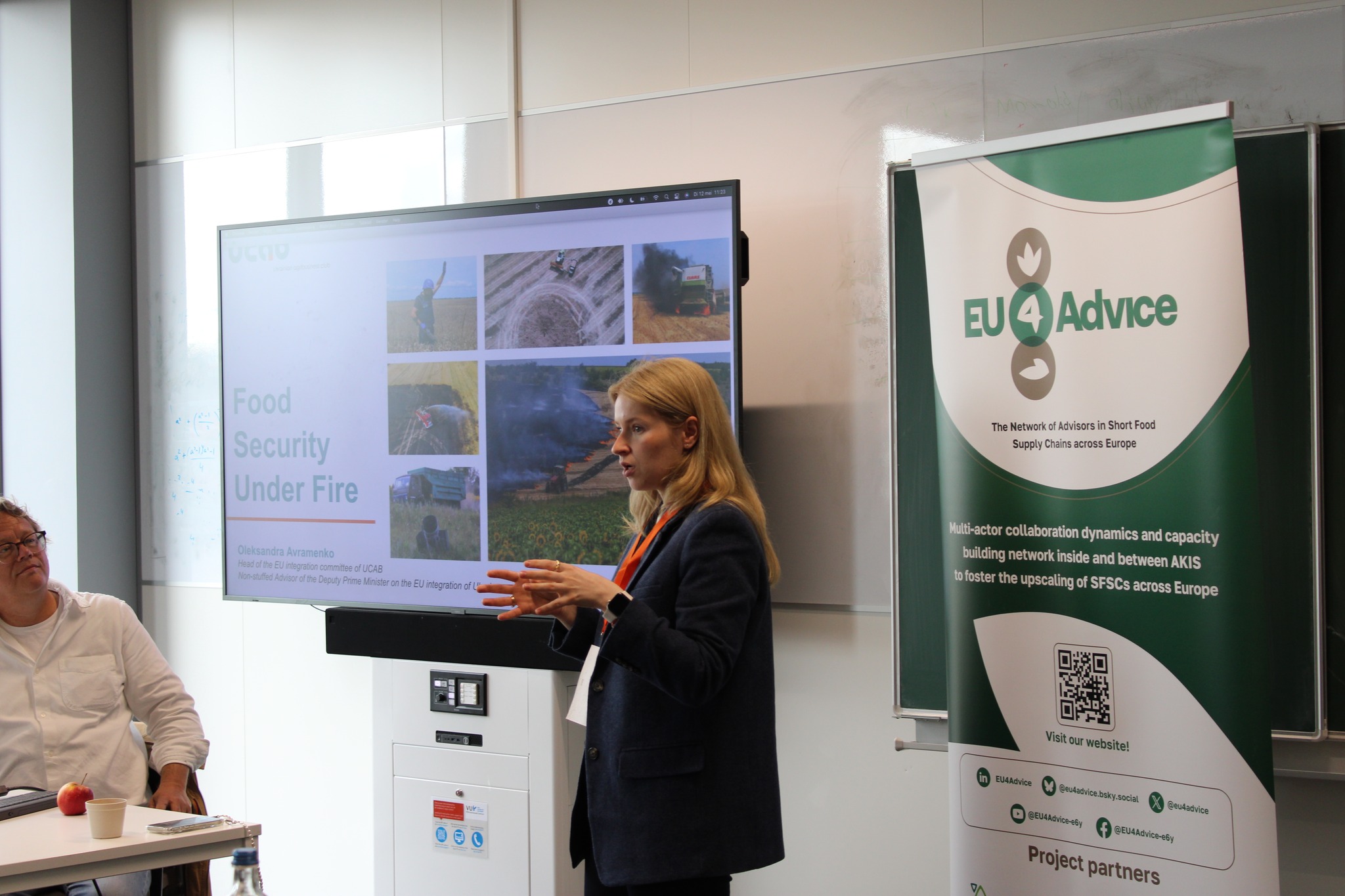
“In times of war, the availability of food stocks in the country does not guarantee their automatic physical accessibility for the population,” noted Oleksandra Avramenko, Head of the European Integration Committee at UCAB, during a workshop at the annual conference of the European Regions for Innovation in Agriculture, Food and Forestry (ERIAFF) network in Amsterdam.
The early period of the full-scale invasion was defined by a rapid transition from stable retail to crisis logistics, and later to stabilization and humanitarian support in liberated cities.
Thus, in March 2022, Kyiv and the surrounding region faced not only a limited food supply but also a complex crisis in accessing it. Food accessibility was critically impacted by security restrictions: multi-day curfews, checkpoints, and fuel limits significantly narrowed the time windows for both food delivery by producers and purchasing by consumers.
Special attention was given to the role of Ukrainian producers, retail networks, logistics operators, local authorities, and volunteers, who managed to maintain the functioning of food supply chains amidst war risks and massive disruptions. It was also emphasized that energy resilience has become an integral part of food security, especially during prolonged power outages, severe frosts, and increased strain on generators, warehouses, production facilities, and retail.
For European producers and regions, this experience is becoming increasingly significant. Climate risks, energy instability, fuel shortages, hybrid threats, and geopolitical turbulence can impact food systems across Europe. Ukraine has already faced these challenges in their most acute form and can offer practical lessons to enhance the preparedness and resilience of European food systems.
It was also highlighted that sharing the Ukrainian experience and practical knowledge gained during the full-scale war is a vital part of the broader position of UCAB and its member companies regarding the synergies of future EU membership. Ukraine’s accession to the European Union is not just about Ukraine integrating into the common market and adapting to European rules and standards, but also about strengthening the EU itself through Ukrainian resilience, crisis experience, and the ability to maintain food systems under extreme conditions. That is why Ukraine sees itself not merely as a future part of the EU agri-food system, but as an active participant in shaping its resilience, strategic autonomy, and crisis preparedness.